Here you can find the latest news and surgical articles.
3 October 2026
Liposuction Cannula Types and Their Uses
Key Takeaways
Select cannula types to suit the operative need. Suction cannulas manage bulk adipose extraction. Infiltration cannulas inject tumescent fluid. Dissecting cannulas sever fibrous septa. Harvesting cannulas maintain graft viability. Specialty cannulas meet sensitive or niche anatomy. Use this match to optimize efficiency and minimize complications.
Choose tip design according to tissue and objective because Mercedes, spatula, basket, and multi-hole tips trade off between aspiration efficiency, clog risk, and surface smoothness. Pick spatulas or micro cannulas for superficial sculpting and basket or multi-hole tips for fibrous or revision cases.
Balance diameter and length to optimize speed and precision because larger diameters speed bulk removal but raise trauma risk, while microcannulas improve contouring and safety. Select lengths that extend to the treatment zone without compromising control.
Incorporate new tech wisely as power-assisted, ultrasound, and radiofrequency devices may enhance consistency, lower surgeon weariness, and provide skin-tightening advantages. Each demands particular technique and knowledge of thermal or mechanical hazards.
Make clinical selection patient-specific by evaluating anatomy, fat depth, previous surgeries, and aesthetic goals. Record decisions to facilitate reproducible results and informed consent. Use a checklist to verify cannula type, tip, diameter, length, and any adjunct device prior to initiation.
Keep evaluating new cannula designs and evidence to refine practice and reduce complications. Implement practical steps such as trialing microcannulas for fine contouring, standardizing infiltration technique, and tracking graft viability when harvesting for lipotransfer.
Liposuction cannula types are the various metal tubes by which fat is extracted during liposuction. They differ in length, diameter, the shape of the tip, and the arrangement of holes to accommodate specific body areas and techniques.
Smaller cannulas help fine contouring, while larger ones move more volume. Rigid and flexible options are tailored to surgeon preference and patient anatomy.
It impacts your recovery, scarring, and ultimate smoothness, which the primary article covers in detail.
Core Categories
Cannula types group by intended use and key design features: suction (aspiration), infiltration (tumescent delivery), specialty (region-specific), harvesting (fat-graft retrieval), and dissecting (fibrous breakdown). Each fulfills different procedural requirements by removing, delivering, preserving, or manipulating tissue and comes with trade-offs in speed, safety, and precision.
Here’s a table outlining key features and common applications.
Category
Main characteristics
Primary application
Advantages
Limitations
Suction cannula
Variable diameters, multiple aperture patterns, often blunt tip
Bulk fat removal in traditional/tumescent lipo
Efficient aspiration, fast volume removal
Risk of contour irregularity, dermal injury if oversized
Infiltration cannula
Multiple small holes, flexible shafts
Even tumescent solution delivery
Uniform anesthesia and vasoconstriction, less pain
Requires skill for even spread; slow for large areas
Specialty cannula
Micro tips, ergonomic handles, unique shapes
Delicate zones (cheeks, inner thigh)
High precision, reduced surface trauma
Slower, may need many passes
Harvesting cannula
Gentle apertures, larger lumen, smooth interior
Fat harvest for grafting
Preserves adipocytes, improves graft take
May limit rapid bulk removal
Dissecting cannula
Reinforced shaft, cutting or beveled tips
Fibrous tissue release, scarred areas
Breaks adhesions, aids deep extraction
Higher trauma risk if misused
1. Suction Cannula
Suction cannulas are designed to transport high volumes of fat effortlessly during both traditional and tumescent techniques. Diameter and aperture design alter flow rate and shear on tissue. A 4 to 6 mm cannula extracts fat more quickly than a 2 to 3 mm microcannula.
Bigger gadgets slice time but increase the risk of lumpy lines and skin damage. Blunt tips and rounded edges are typical these days to spare the subdermal vascular plexus and minimize bleeding and bruising.
2. Infiltration Cannula
Infiltration cannulas place tumescent fluid where it’s needed. Several hundred tiny holes distributed along the shaft distribute saline, anesthetic, and epinephrine uniformly, providing even tumescence and vasoconstriction. Expandable tubes avoid accidental deep puncture into muscle or veins.
Technique matters: slow, measured injections and systematic coverage make procedures safer and more comfortable, especially for awake patients.
3. Specialty Cannula
Specialty cannulas are for hard-to-reach areas and precision work. Microcannulas and finesse designs permit superficial passes beneath thin dermis without dimpling. Ergonomic handles and angled tips provide greater precision in curved or tight spaces.
Small-curved cannulas are for the malar and narrow long-shaft models are for medial thigh access. A quick-reference listing of common models and their uses helps surgical planning.
4. Harvesting Cannula
Harvesting cannulas seek to preserve fat cells for grafting. They utilize mild vacuum, curved openings and spacious channels with lubricious surfaces to minimize cell damage. A larger lumen assists in moving fat without clogging.
The aspiration pressure must be low. We compare designs by cell survival data and ease of processing to guide selection for graft quality.
5. Dissecting Cannula
Dissecting cannulas disrupt fibrous septa and dense fat. Reinforced shafts and specialized tips allow the surgeon to navigate through scarred tissue and male gynecomastia safely. They optimize access in formerly worked areas.
Abuse brings trauma and hurt, therefore skilled method and careful strength are necessary.
Tip Configurations
Cannula tip design impacts fat aspiration, how much tissue trauma occurs, and the cosmetic outcome. Tip shape affects flow characteristics, clogging potential, and shear stress at the fat–dermis boundary. Tip configurations and tip selection matched to fat layer, regional anatomy, and procedure type minimize complications and increase contour precision.
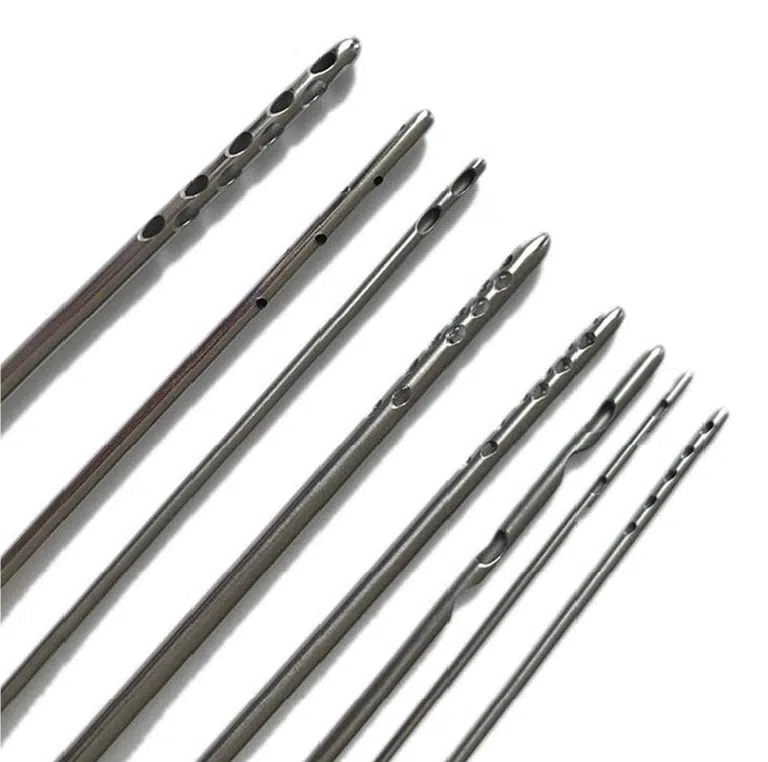
Mercedes Tip
The Mercedes tip features three rounded holes arranged equidistantly around the tip, which equalizes suction and reduces the risk of clogging. This configuration provides consistent suction with less aggressive pulls, so fat exits in tinier, more controllable chunks.
Popular in both traditional and tumescent liposuction, it fairs well for large-volume cases where uninterrupted flow is a factor. In regions of moderate fibrousness—flanks, abdomen, and thighs—the Mercedes tip navigates tissue planes without unnecessary aggression.
Compared to single-hole cannulas, it usually causes less dermal friction and less post-operative ecchymosis, which helps decrease bruising and accelerates early recovery.
Spatula Tip
Spatula tips have a flat, wide end that distributes suction over a larger area. They function optimally at the superficial subcutaneous level and for contouring near the dermis.
When treating sensitive areas like the infraorbital, cheeks, or neck region, spatula tips minimize dimpling or focal depression. Their broad design allows the physician to extract slender strips of fat with precise control, safeguarding the skin and reducing deformities.
Use spatula tips for finishing work after bulk extraction. They smooth transitions, soften edges, and refine contour where precision matters.
Basket Tip
Basket tips have multiple small holes configured in a basket-like pattern close to the tip. That arrangement distributes suction forces and facilitates movement through sinewy, scarred or re-operated tissue.
In secondary or revision liposuction, basket cannulas decrease the force required to extract difficult fat deposits and minimize clogging compared to bigger single apertures. They permit slow controlled aspiration, which is ideal when scar tissue may tether fat to deeper structures.
Suggested for revision situations, traumatic or scarred troubled territories such as the male chest or inner thigh.
Multi-Hole Tip
Multi-hole tips have many tiny holes distributed along the distal shaft. They offer uniform extraction over more area, which helps yield smooth contours and less postoperative irregularities.
Especially for tumescent and microcannula approaches, multi-hole designs decrease localized shear and guard fragile tissues. Variations exist in aperture size and spacing.
Closely spaced tiny holes suit very superficial smoothing, while slightly larger, more spaced holes suit moderate debulking. Select according to target layer thickness and finish.
Mercedes: balanced flow, low clogging, large-volume use
Spatula: broad spread, superficial sculpting, final contouring
Basket: diffuse suction, good for fibrous/revision cases
Multi-hole: even extraction, microcannula/tumescent smoothing
Dimensional Variables
Cannula size, diameter and length, are variables that directly influence the liposuction planning and execution process. They impact how quickly tissue is excised, how effortlessly the tip slices through layers of fat, and the amount of control the surgeon yields. Select dimensional variables to correspond to the targeted fat layer, patient body habitus, and technique.
Diameter Impact
Increasing cannula diameter accelerates fat removal because a wider lumen transports aspirate more rapidly and resists obstruction. This entails increased shear forces on tissue and more blunt trauma to fat lobules and septa, thus increasing the risk of surface irregularities and contour defects.
Large cannulas are ideal for deep volume removal in the abdomen and outer thigh where size trumps precision. Thin cannulas and microcannulas minimize surface trauma and are superior for superficial layers, small-volume sites, and areas with thin subcutaneous tissue, such as the neck and medial arms.
They permit more delicate carving, maintain skin connections, and reduce the chance of puckers or indentations. They demand more passes and more time. Microcannulas complement technologies such as power-assisted liposuction and ultrasound-assisted liposuction for controlled superficial aspiration.
Surgeons have to balance speed with accuracy and security. For instance, four to five millimeter cannulas rapidly aspirate large fat volumes in main abdominal work, whereas two to three millimeter cannulas provide superior outcomes on the infra-axillary and lower back regions.
Best practice is a mixed-size strategy: start with larger cannulas for bulk reduction and switch to smaller ones for contour refinement and superficial smoothing.
Length Requirements
Cannula length should correspond to the depth and width of the fat compartment being addressed. Shorter cannulas offer tactile sensation and more precise control in tight areas such as the submental or peri-orbital regions. They constrain reach, thereby minimizing the necessity of long trajectories and the risk of inadvertently cutting into another plane.
Longer cannulas provide access to deeper tissue planes and enable treatment of extensive areas with fewer access points. They come in handy for flank-to-back sweeps and full-thigh longitudinal passes.
Longer instruments decrease tip feedback and amplify leverage forces, both of which can compromise accuracy and increase penetration risk. Over-length makes for difficult handling and can demand more refined technique to prevent deep tissue damage.
Standard practice lists common lengths: 10 to 15 cm for small facial and neck work, 18 to 25 cm for torso and limb treatments, and up to 30 cm for extensive body contouring. Choose length considering incision placement, tunneling angles, and the surgeon's reach.
Body Region
Typical Diameter (mm)
Typical Length (cm)
Technique Fit
Submental/Neck
1.5–2.5
7–12
Microcannula, fine sculpting
Arms/Medial Thigh
2 to 3.5
12 to 18
Superficial and contour work.
Abdomen/Flanks
3.5 to 5.5
18 to 25
Bulk removal, deep layers
Back/Outer Thigh
4 to 6
20 to 30
Large volume aspiration
Modern Technologies
Modern devices reinvent cannulas by introducing energy or vibration to optimize fat extraction, minimize the surgeon’s exertion, and seek more reproducible results. Here are the main platforms now combined with conventional cannula types, with comments on where they contribute and where to be careful.
Power Assistance
Power-assisted liposuction (PAL) utilizes a mechanically oscillating cannula to increase fat aspiration speed. The oscillation may be provided by electric motors or by gas-driven units, which require medical compressed gas and add cost and logistics. PAL has progressed from standard cannulas to thinner microcannulas with less tissue trauma.
Microcannulas with PAL can improve comfort and reduce surface irregularities when performed properly. PAL systems decrease surgeon fatigue and allow more consistent strokes which is beneficial in fibrous regions and large-volume cases where manual swiping is exhausting. Some surgeons say PAL is especially beneficial in revision work where scarred tissue defies suction.
PAL’s effectiveness probably has to do with vibration rate, but studies are inconsistent as to whether faster or slower oscillation is optimal. Settings are usually customized to tissue type and surgeon preference. Good technique is still relevant to prevent undue tissue trauma with powered cannulas.
Even microcannulas can cause damage when pushed too aggressively. The powered motion needs to be married with slow, controlled movement and depth awareness. Here is a comparison of top PAL devices and destinations.
Device
Power Source
Notable Feature
Classic electric PAL
Electric
Wide range of vibration settings
Gas-driven PAL
Compressed gas
High power, mobile handpiece but needs gas tanks
Micro-PAL systems
Electric
Designed for microcannulas, finer control
Ultrasound Integration
Ultrasound-assisted liposuction (UAL) employs ultrasonic energy to liquefy fat prior to aspiration. The energy assists in disrupting fibrous septa and liquefying hard fat, facilitating suction. UAL is effective in fibrous areas and revision with scar tissue in which manual cannulas have difficulty.
Ultrasound enhances tissue penetration and minimizes the surgeon’s effort. It extends setup and must be skillfully applied for safety. There is a risk of thermal damage or burns to the skin if too much energy is delivered or if the dwell time is too long.
Careful temperature monitoring and small passes reduce these risks. UAL systems (e.g. Vaser) are still advancing. Clinicians are still establishing ideal energy ranges and methods for various tissues.
Radiofrequency Systems
Radiofrequency-assisted liposuction (RFAL) marries fat removal with concurrent skin contraction through the use of RF energy. RFAL is appealing for patients desiring contour enhancement and mild skin tightening without a distinct skin excision surgery. In clinical use, RF can accelerate healing and reduce the amount of skin that needs to be removed in certain patients.
RF systems differ in delivery and indication, some being preferable for superficial tightening, others for deep tissue heating. Here is a quick device reference chart.
Clinical selection directs what cannula type, tip, and size will best work for a particular patient. Clinically select based on skin quality, subcutaneous fat thickness, fibrous bands, previous surgery, and the final desired contour. Match cannula diameter and tip design to those anatomic factors.
Larger, fluted cannulas speed bulk fat removal in loose, thick-fat areas. Microcannulas allow fine work where skin is thin or precision is required. Clinical selection impacts fat removal efficiency, tissue trauma, hemostasis, scarring, and final aesthetic outcome.
Surgeon objectives and patient hopes inform choice. If broad debulking of the abdomen is the goal, a 3.5 to 5.0 mm cannula with multiple ports or a flared tip can remove larger volumes rapidly. For arms, infra-mammary, or periorbital areas, use microcannulas (1.5 to 2.4 mm) to minimize surface irregularity and bruising.
Consider a slightly smaller cannula than you typically use. Both research and experience demonstrate that the smaller the size, the less trauma and the smoother the contour. Power-assisted liposuction (PAL) can increase extraction efficiency by approximately 30 percent beyond manual methods, decrease operative time, and reduce surgeon fatigue.
So consider PAL compatibility when selecting cannulas if you use that device.
Consider tissue type and background. Fibrotic areas post weight loss or previous surgeries require more rigid cannulas with cutting edge or reciprocating tips to penetrate scar tissue. Lax tissues react more favorably to cannulas with rounded, blunt tips to minimize internal tearing.
Material and design matter: stainless steel with polished shafts glides differently than coated or textured cannulas. Some designs place holes on one side to direct aspiration and limit dimpling. Prefer designs that allow you to maintain control over vector and depth.
Use a practical checklist to guide selection:
Patient anatomy: skin thickness, fat depth, fibrous content, elasticity — choose diameter and tip accordingly.
Surgical goal: Debulk versus sculpt — larger multiport cannulas for volume and microcannulas for detail.
Prior procedures: fibrosis or implants. Select stiffer or beveled tips for access.
Device compatibility: PAL, ultrasound, or laser-assisted systems. Ensure cannula fits energy device.
Trauma minimization: Prefer smaller cannulas and blunt tips where possible to reduce bruising and scarring.
Operative efficiency: Consider PAL when case size or surgeon fatigue is a concern.
Material and port pattern: choose based on glide, visibility, and directional aspiration needs.
Safety limits include plan entry sites, depth markers, and avoiding overly large diameters near thin soft tissue.
These more experienced surgeons integrate the checklist with tactile feedback to customize cannula choice intraoperatively, moving sizes or tip styles in response to tissue feedback.
Critical Insights
Best liposuction results depend on a precise matching of cannula design to procedure need. Unique body zones, fat types and patient objectives necessitate specialized tools. For instance, a large-bore straight cannula measuring 3 to 5 mm accelerates fat extraction in the abdomen but proves too aggressive for the infraorbital region, where a finer, flexible cannula measuring 1 to 2 mm maintains contour and minimizes bruising.
Matching cannula length to reach depth without unnecessary tissue trauma aids in keeping OR time and fluid shifts lower. Poor decisions can prolong recovery, cause more swelling and increase complication risk.
Key to our surgical success was understanding cannula efficiency, tip design, and dimensional factors. Effectiveness varies by lumen size, tip design and wall thickness. A bigger lumen shifts fat quicker but requires bigger incisions and can suck up more connective tissue.
Blunt, rounded tips displace tissues and reduce severed vessel risk, while sharp or flared tips break up fibrous fat and assist in fibrous areas such as the male chest or back. Cannula stiffness impacts control. Rigid cannulas provide force to access dense areas, while flexible cannulas decrease trauma in curved zones such as the flanks.
Length and port placement patterns, such as a single long opening versus multiple small ports, alter suction patterns and the sensation of feedback through the handpiece.
It’s obvious that the latest technologies have a place in safety, complication reduction, and patient satisfaction. Power-assisted liposuction (PAL) uses reciprocating cannulas to reduce surgeon fatigue and increase speed. Studies demonstrate decreased procedure time and comparable complication rates when appropriately applied.
UAL and its cousin laser-assisted variants emulsify fat before extraction, which is helpful in fibrous or secondary cases, but they introduce a thermal element that necessitates meticulous technique in order to avoid burning the patient. Tumescent technique combined with pressure-regulated aspirators balances bleeding and fluid removal.
Combining closed systems with real-time suction monitoring reduces the risk of over-resection. Employing adjuncts such as microcannulas for superficial smoothing following bulk excision enhances skin retraction and aesthetic sheen.
Continuous evaluation of emerging cannula designs and methods is essential to maintain best practice. Track device-specific evidence: donor-site morbidity, seroma rates, and long-term contour stability. Test new cannula profiles in controlled settings, compare outcomes versus established tools, and note learning curves.
Consider hybrid approaches, starting with PAL for bulk and finishing with microcannulas for refinement, or combining UAL for release in scarred tissue then PAL for aspiration. Train teams on exchange protocols and maintenance to avoid device failure mid-procedure.
Conclusion
Choosing the right cannula sculpts your liposuction outcome. Match cannula length, diameter, tip style, and hole pattern to area, fat type, and patient goals. Short, thin cannulas work best for the face and small zones. Fatter cannulas of greater length and width dislodge fat rapidly in big areas such as the abdomen. Blunt-tipped cannulas reduce the likelihood of skin dimples. Multiport and fan tips disperse energy and create even surfaces. Power and ultrasound devices enhance fat disruption but require softer, specialized cannulas. Inquire about tissue sensation, scar strategy, and recuperation duration. Use photographs or statistics from previous cases to guide selections. For one last review, read up on technique, incision placement, and post-op care to safeguard results and accelerate healing.
Consider discussing options with your surgical team.
Frequently Asked Questions
What are the main types of liposuction cannulas?
The primary varieties include blunt-tipped, sharp-tipped, multi-port, and microcannulas. Each type is best suited for varying tissue planes and accuracy requirements. Surgeons select according to area, fat compactness, and safety.
How do tip configurations affect outcomes?
Tip shape and port pattern govern fat disruption and suction efficiency. Blunt tips minimize tissue trauma. Multi-port tips make it faster. Preference balances smoothness, bruising, and recovery.
What dimensional variables matter when selecting a cannula?
Other important variables are diameter (mm), length (cm), and port size. The smaller the diameter, the finer the sculpting that can be done. Larger diameters simply remove the bulk faster. Length varies based on treatment area depth and reach.
Are there modern technologies integrated into cannulas?
Yes. Some cannulas are incorporated with vibration, ultrasonic, or laser assist. These technologies assist in emulsifying fat, reducing physical effort, and enhancing accuracy and patient comfort.
How does clinical selection vary by treatment area?
Surgeons correlate cannula type to anatomy. Face and neck require microcannulas. Abdomen and thigh liposuction typically involves the use of larger, multi-port cannulas for more efficient fat removal. Safety and contour objectives direct selection.
What are common safety considerations for cannula choice?
Opt for blunt tips to safeguard close to sensitive areas. Match the diameter to surgeon skill to prevent irregularities. Maintain equipment sterility and appropriate handling to minimize complications.
How can surgeons improve aesthetic results with cannula selection?
Mix and match cannula sizes and tip patterns during a procedure. Begin with larger cannulas to remove the bulk, then finesse with microcannulas. This strategy improves contouring and reduces bumpiness.